Community Colleges & Community
Beyond Degrees: Lifelong Learning at Foothill-De Anza
From tuition-free classes and career certificates to English-language learning, senior programs, and community enrichment.
October 14, 2026 · By Liang Chao
At a Glance: Lifelong Learning at Foothill-De Anza
- Beyond Degrees: Credit classes, career certificates, and lifelong learning opportunities for every stage of life.
- Tuition-Free Learning: Noncredit classes in AI, technology, ESL, career skills, and many other subjects.
- Recognized Achievements: Noncredit certificates that recognize skills and progress without requiring a degree.
- English and College Pathways: ESL classes, tutoring, certificates, and adult-school dual enrollment.
- Learning at Every Age: Senior Guided Pathways for adults 50+ and Community Education for children and adults.
- Easier Access: Opportunities to improve awareness, simplify enrollment, and connect more residents with available programs.
Education doesn't end when we earn a degree, begin a career, or retire.
Community colleges are often recognized for providing affordable pathways to four-year universities and career training. But they also offer something equally valuable: opportunities for people to return to learning throughout their lives. A young person might want to explore a new subject, a new immigrant may want to improve English skills, a working professional may need to update technical knowledge, and a retiree may want to pursue a lifelong interest or prepare for a new chapter.
Foothill and De Anza already offer a remarkable variety of programs serving these different needs. Many are tuition-free, and some lead to certificates recognizing the skills students have gained. As a current Foothill-De Anza student myself, after nearly three decades working in high technology, I've come to appreciate the opportunity to keep learning alongside people of different ages and backgrounds. I would love to see more community members discover these opportunities.
Tuition-Free Noncredit Classes: More Than You Might Expect
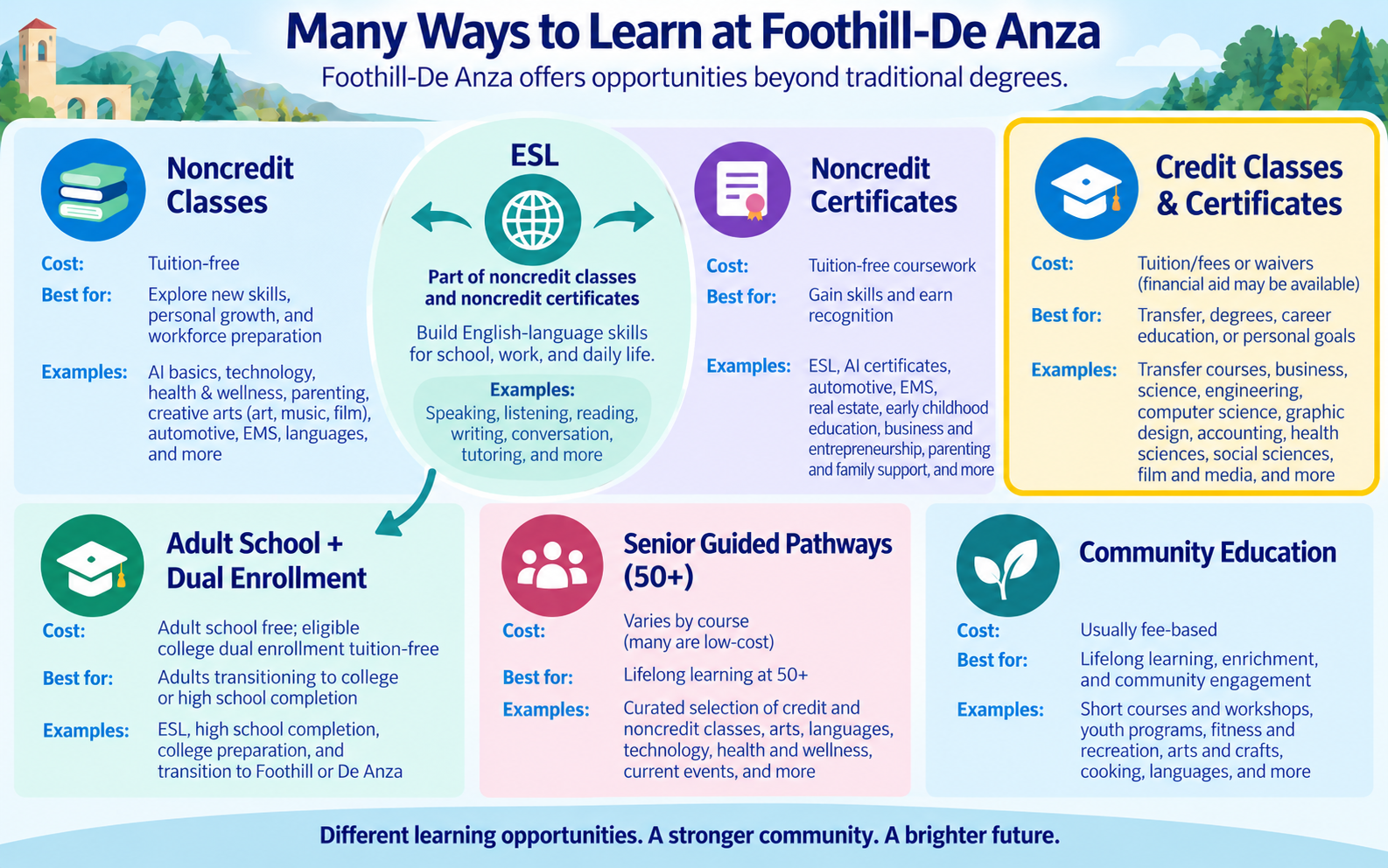
Did you know that you can take many college classes at Foothill and De Anza without paying tuition or working toward a degree? These are called noncredit classes. They provide structured learning without awarding academic units toward a degree or university transfer, and students may still need to pay for books or materials.
At De Anza, noncredit offerings include automotive technology, computer science and information systems, English as a Second Language (ESL), mathematics, photography, and real estate. Foothill's noncredit programs include ESL, academic preparation, emergency medical services, health sciences, parenting education, vocational training, and adaptive learning for adults with disabilities.
Some noncredit courses cover the same material as their credit counterparts, with similar academic expectations. Others are designed specifically for adult education or workforce preparation. For example, I'm taking a noncredit course called Reframing Problems with AI, while fellow students are taking noncredit courses in Prompt Engineering and Responsible AI. These can lead to noncredit certificates, without committing to a degree program.
English for New Beginnings: ESL Classes and Certificates
For immigrants building a new life in the United States, improving English skills can open doors to employment, further education, and fuller participation in the community. Yet many people may not realize that local community colleges offer tuition-free ESL classes, certificates recognizing their progress, and opportunities for free tutoring, including one-on-one assistance.
Foothill's ESL program offers noncredit English-language classes at several levels, along with certificates in areas such as beginning and intermediate ESL, English for college and careers, and English for food service workers. It also offers English-language learning connected to child development. Students can also explore Foothill's free Pass the Torch peer-tutoring program, which includes one-on-one study teams for eligible ESL coursework.
De Anza's noncredit ESL program offers courses and certificates in areas including intermediate and advanced English, pronunciation, grammar, and writing. These certificates recognize students' accomplishments as they develop their language skills and provide milestones along a longer educational journey.
De Anza expanded its noncredit ESL certificate offerings in 2024–25. According to the district's Student Program Award Report, students receiving noncredit certificates in the General Studies/ESL category increased from 68 in 2023–24 to 376 in 2024–25. This represents a substantial increase in recognized educational achievement.
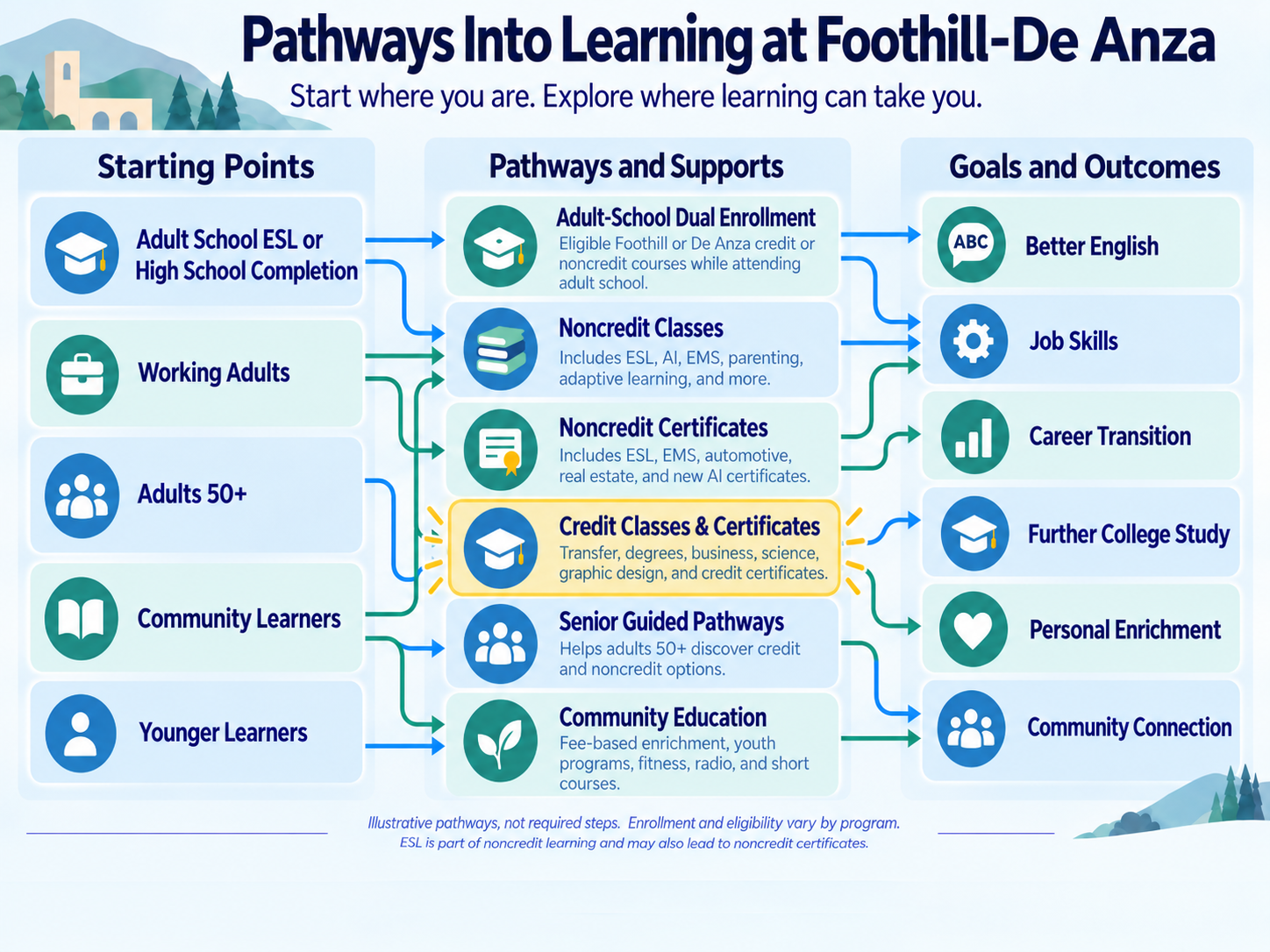
Local adult schools are another important part of this educational network. Fremont Union High School District Adult School offers free ESL classes and helps eligible adult-school students transition to Foothill or De Anza through adult-school dual enrollment. Students can take eligible college courses tuition-free while continuing their adult education, with guidance from a transitions counselor. This creates a pathway from learning English or completing high school to college certificates, career training, and degrees.
Different institutions offer different starting levels, and adult schools may be a better first step for students with very limited English. However, FUHSD Adult School has reported that its ESL program is at capacity, making it particularly important for prospective students to know about other available programs. I would love to see stronger awareness and coordination so that new immigrants and their families can more easily find appropriate classes, tutoring, and enrollment information through local schools, libraries, and community organizations.
Noncredit Certificates: Building Skills Without Pursuing a Degree
Noncredit education is not limited to taking individual classes. Students can also pursue certificates of completion or competency, which typically require completing a defined sequence of courses and recognize the knowledge and skills they have acquired.
For example, De Anza offers noncredit certificates in automotive technology, including Automotive Chassis Technology, General Service Technician, and Smog Technician. Foothill offers certificate pathways in areas such as emergency medical services, English-language learning, and career-related technical skills. These programs can be particularly valuable for people exploring a new career, returning to the workforce, or updating skills after years in an industry.
Noncredit certificates are different from credit-bearing academic certificates or industry licenses, and their employment value depends on the program and the skills involved. Nevertheless, they provide tangible recognition of progress and can serve as stepping stones toward further education. As technology changes the workplace, including through artificial intelligence, opportunities to develop new skills throughout our careers will become increasingly important.
Senior Guided Pathways: Learning Doesn't Stop at 50
Learning later in life isn't limited to recreation. Older adults may want to begin a second career, update professional skills, explore new technologies, or study something they've always been curious about.
De Anza already offers Senior Guided Pathways, developed in partnership with Successful Aging Solutions & Community Consulting (SASCC). The program brings together selected credit and noncredit courses for adults 50 and older, covering subjects such as art, languages, science, business, computer science, and real estate. It also provides opportunities for older adults to mentor younger students through De Anza's Village Centers, creating meaningful connections between generations.
West Valley College, where the Senior Guided Pathways model was first developed, offers additional examples of how educational pathways can support adults navigating retirement, career changes, and other life transitions. Older adults can enroll in regular community college courses for which they meet the requirements; Senior Guided Pathways helps them discover and navigate offerings that may interest them. Community colleges can help people continue learning, contribute their experience, and remain engaged with their communities well beyond traditional college age.
Community Education: Learning for the Joy of It
Not every learning experience needs to lead to a certificate or career. Both Foothill and De Anza also offer Community Education, which is generally fee-based and separate from state-supported, tuition-free noncredit education. These programs offer opportunities for personal enrichment, recreation, and professional development without requiring students to pursue academic credit.
De Anza's Community Education activities include adult Short Courses, College Academy programs for children and teens, Planetarium programs, and other educational and cultural activities. Its Short Courses cover subjects ranging from technology and business to arts, languages, and personal enrichment. Foothill Community Education also offers activities, including fitness and radio broadcasting instruction, and its college catalog describes Community Education as serving both adults and younger learners.
Whether someone wants to learn photography, explore technology, improve fitness, or develop a creative interest, learning has value beyond academic credentials.
Making Lifelong Learning Easier to Discover and Access
Foothill and De Anza already have a strong foundation of programs serving people at different stages of life. The opportunity is not simply to add more classes, but to help more residents discover what's available and make it easier to participate.
Awareness and outreach are an important starting point. Information about noncredit classes, certificates, ESL, Senior Guided Pathways, and Community Education should be easy to find, including through local schools, libraries, employers, and community organizations. Multilingual information could be particularly helpful for immigrant families who may not be familiar with the American community college system.
Convenient enrollment and clear learning pathways also matter. West Valley College, for example, offers a simplified application for students taking only noncredit courses. It would be useful to examine whether Foothill and De Anza could offer a similarly straightforward process, rather than requiring students who only want to take noncredit classes to navigate the full college application process.
Finally, programs should continue responding to community needs. Partnerships with local employers, adult schools, cities, and community organizations can help identify changing educational interests and workforce requirements. Flexible schedules, online and hybrid courses, and learning opportunities at community locations can also make participation more convenient. These efforts should build on the work already being done by faculty, staff, and community partners, with attention to student needs and available resources.
Foothill-De Anza for Every Stage of Life
My own experiences as a student, parent, classroom volunteer, college professor, school board member, and now a community college student again have given me a deep appreciation for the many roles education plays in our lives.
Community colleges should be places where people can begin a degree, prepare for a career, return to learn new skills, improve their English, explore personal interests, or share their knowledge with the next generation. They are not just stepping stones to a university or a job, but community resources that people can return to throughout their lives.
Not every learner needs a degree. But everyone deserves opportunities to learn.
That is part of my vision for Foothill-De Anza for Every Stage of Life.
Explore Learning Opportunities
- Foothill — Tuition-Free Noncredit Programs
- Foothill — ESL Courses and Certificates
- Foothill — Free One-on-One Peer Tutoring
- De Anza — Noncredit ESL Courses and Certificates
- De Anza — Noncredit Automotive Technology
- De Anza — Senior Guided Pathways
- De Anza — Community Education Short Courses
- Foothill — Community Education
- FUHSD Adult School — Free ESL and Citizenship Classes
- De Anza — Adult-School Dual Enrollment